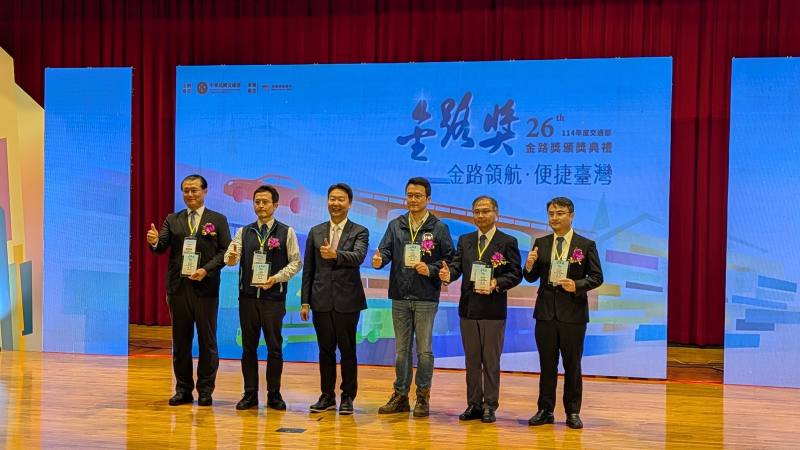
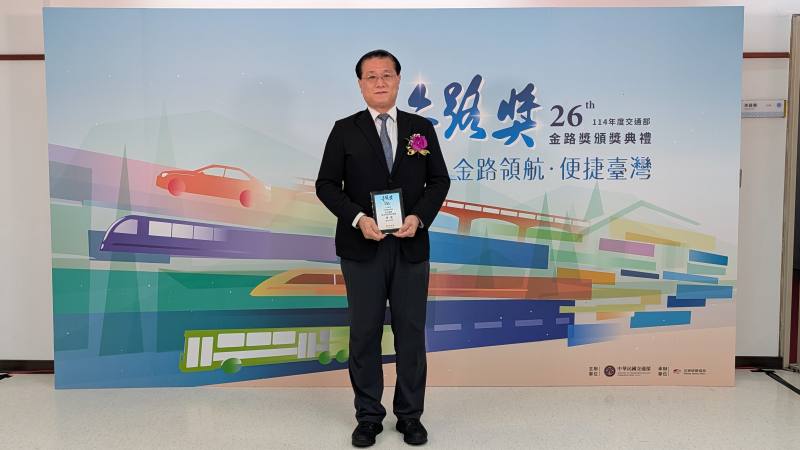
The Railway Bureau, MOTC held the "2025 26th MOTC Golden Way Award Ceremony" at the Performance Hall on the 5th Floor of Taipei Main Station on December 12, 2025, and the Taipei City Government, following 2024, again received an Outstanding placement in the "Road Condition Maintenance Category/County and City Government Road Condition Maintenance/Outstanding/Special Municipality" item.
The New Construction Office, Public Works Department, Taipei City Government stated that there are a total of 8 roads under Taipei City's jurisdiction, with a combined maintenance route length of approximately 73.3 kilometers, most of which are major urban roads and important connecting roads to New Taipei City, and some are roads serving mountainous areas, all of which are key roads for Taipei City's maintenance. The Taipei City Government takes "Technology, Innovation, and Sustainability" as its core, introducing new construction methods, new materials, and intelligent management to enhance the efficiency of road management.
The New Construction Office explained that the maintenance operations for roads and ancillary facilities in Taipei City involve several agencies, and the Taipei City Government has integrated the related operations and implemented smart management, establishing information systems including a road maintenance management system, a 3D pipeline database, AI automated identification of road defects, ground-penetrating radar inspections of underground cavities, and pavement PCI surveys. To improve road management, a comprehensive survey is conducted for roads and sidewalks, and using the latest spatial information technologies, panoramic imagery and related data are integrated and interfaced to establish a "visual management platform system" to integrate and manage the City’s roads and the road ancillary facilities managed by various agencies.
The New Construction Office further explained that road maintenance in Taipei City has introduced the "Pavement Condition Index (PCI)" survey and the "performance based contract for road patrol, maintenance, and repair". The PCI uses orthophotos for assisted interpretation, and an automated stereoscopic panoramic inspection vehicle and an AI defect identification system have been developed, with related data incorporated into an information system for integrated display, establishing a Taipei City pavement condition database as an important basis for subsequent road maintenance planning and budget utilization. The "Performance-Based Contract (PBC) for Road Patrol, Maintenance, and Repair" differs from traditional technical and process-oriented contract models in that it is a new type of contract that uses output and performance objectives as the evaluation basis, and the contractor is paid by the owner after achieving or exceeding the performance indicators originally set. This mechanism enables the contractor to flexibly apply its expertise to innovate and enhance the benefits of project outputs, allowing the owner, the contractor, and the public to achieve a three way win, and bringing an innovative approach to the execution of work for each project.
Finally, the New Construction Office stated that the Taipei City Government has shifted road maintenance from passive to proactive "intelligent management", and will continue to introduce new technologies to establish maintenance management systems and innovative contract models, develop a more scientific basis for maintenance standards, and use budgets effectively to further enhance the efficiency of Taipei City’s road maintenance.