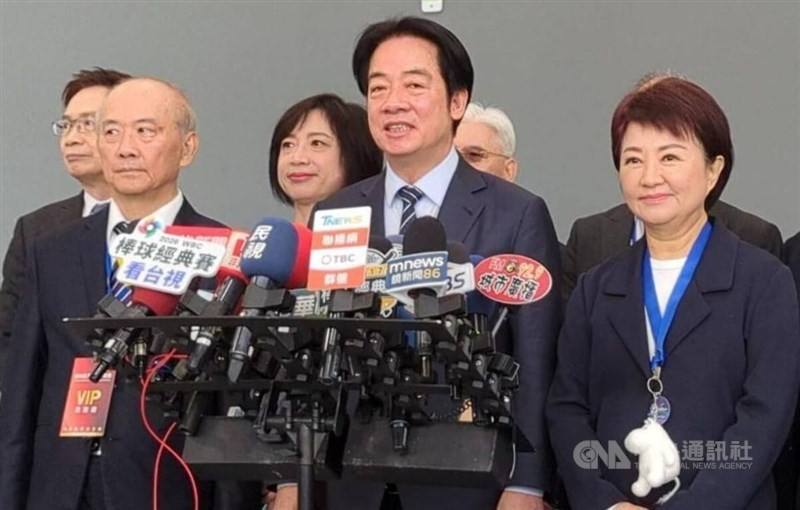
Taipei, Jan. 16 (CNA) An agreement reached Thursday (U.S. time) between Taiwan and the United States to lower tariffs on Taiwanese goods will benefit local non-tech industries by "leveling the playing field" with major trade competitors, President Lai Ching-te (賴清德) said Friday.
"Japan and South Korea had free trade agreements or quasi-free trade agreements with the U.S. Japanese and South Korean goods exported to the U.S. had an advantage over Taiwanese goods," Lai told reporters in Taichung.
"But now, the playing field is level. This actually provides a great opportunity for Taiwanese traditional industries exporting to the U.S.," the president said.
No formal trade deal has yet been signed, with Taiwanese officials hoping it will be concluded in the coming weeks.
But once signed, the new tariff rate of 15 percent, down from the previously imposed 20 percent, would match the U.S. rates on goods from major trade partners such as Japan, South Korea and the European Union.
The two sides also signed a memorandum of understanding (MOU) on investment commitments made by Taiwan to invest more in America's semiconductor and technology sectors.
Lai said that as part of the consensus reached during the negotiations, the U.S. government has agreed to help Taiwanese businesses in acquiring land and accessing utilities and infrastructure, making it easier for them to be integrated into the American economy.
"Not only will there be a 'Taiwanese national team' for U.S. investment, there will also be a 'U.S. national team' investing in Taiwan," Lai said, referring to the MOU.
Taiwan will facilitate U.S. investment in the Taiwanese semiconductor, AI, defense and biotechnology sectors to expand market access for American companies, according to the U.S. Commerce Department, though the agency did not outline specific commitments in the MOU by the U.S. to invest more in Taiwan.
Because any formal trade deal reached with the U.S. must be approved by the Legislature, where opposition parties hold a combined majority, Lai called for nonpartisan support from lawmakers when reviewing the pact.
Under the Conclusion of Treaties Act, once a treaty has been signed, the Cabinet must submit it within 30 days to the Legislature for deliberations.
The Legislature can then reserve or revise the clauses, in which case the treaty must be renegotiated with the other signatory.