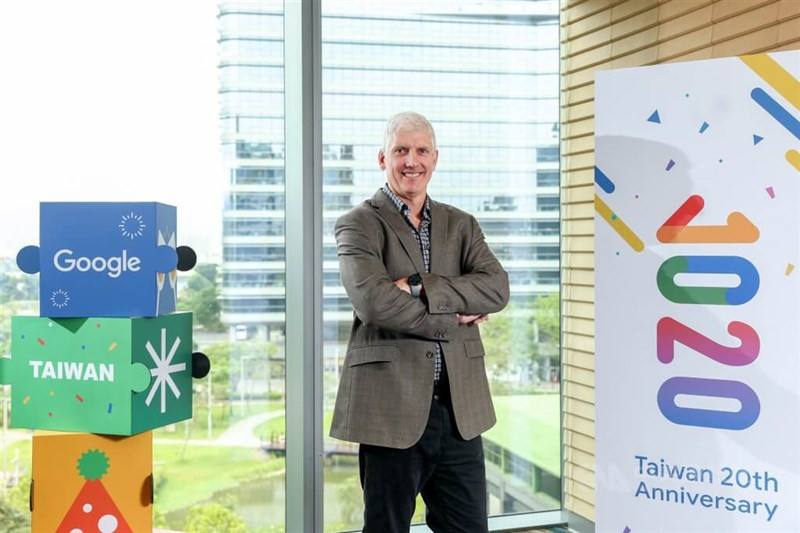
Taipei, April 19 (CNA) Taiwan is playing a "central role" in Google's transition toward AI-based computing, as well as in the broader industry shift, Rick Osterloh, senior vice president of Devices & Services at Google, said in a recent interview with CNA.
Osterloh praised the company's Taiwan team for its "amazing R&D capabilities" and highlighted key partners such as MediaTek and Taiwan Semiconductor Manufacturing Co. (TSMC).
"Our team in the region is so crucial for what we're doing with our global innovation strategy, and central to the shift in the AI computing landscape," he said at Google's hardware engineering center in New Taipei, the company's largest hardware R&D center outside the United States.
Elmer Peng (彭昱鈞), Google's vice president of hardware, also praised Taiwan's strong ecosystem, citing its deep talent pool in silicon design, devices and Android development, as well as the company's data center in Changhua.
He described that ecosystem as being perfectly aligned with Google's "full-stack" strategy, which focuses on offering a comprehensive group of solutions that address every layer of a technology stack.
Osterloh said the company's full-stack approach to AI spans applications, AI models and underlying technology, including data centers and chips.
At the same time, he said, by unifying its ecosystem around the Gemini family, Google enables the same core technology to be used across enterprise services in Google Cloud, automotive systems in Android Auto and consumer devices such as Android smartphones.
For users, this integration enables shared context and memory across platforms, he said, adding that Google is "the only real full-stack provider of AI that can support enterprises and consumers."
Osterloh also introduced a new capability called "Personal Intelligence" that was launched in Taiwan on April 15. The feature builds on a user's interaction history across services such as Gmail and Google Photos to deliver more personalized responses and actions.
Looking ahead, he said, the first generation of "AI-native" devices will need to enhance existing functions, such as calling, photography and web browsing, while incorporating new AI-driven capabilities.
He pointed to recent developments such as "Gemini Task Automation," which enables "agentic workflows" like automatically completing tasks such as booking a ride, as well as the integration of Gemini into the Chrome browser to assist users in real time.
He cautioned, however, that creating completely AI-native devices will require rethinking both user interfaces and underlying technologies to move from an application-driven to an AI-driven computing model.