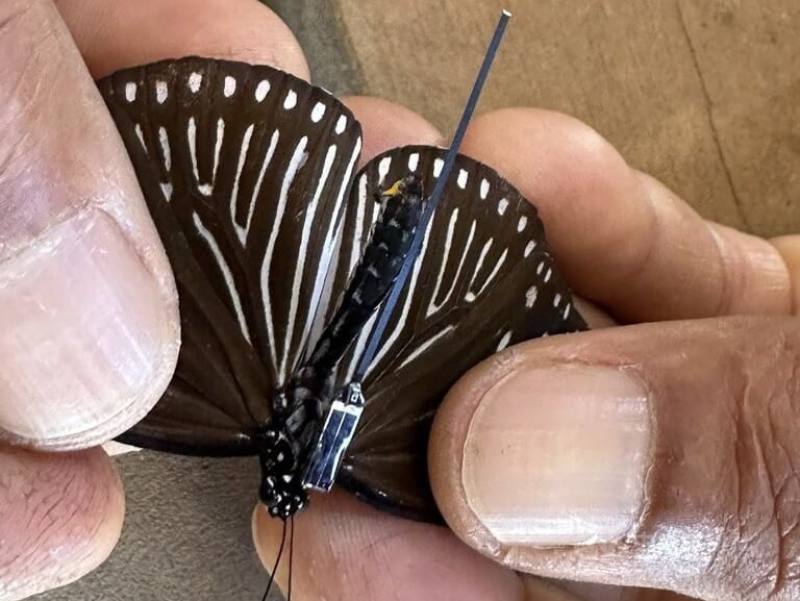
Taipei, Nov. 18 (CNA) Researchers studying insect migration patterns have achieved an Asian first by tagging two butterflies in east Taiwan with 0.06 gram microtransmitters, the East Longitudinal Valley National Scenic Area Headquarters said Wednesday.
In a news release, the headquarters, part of the Tourism Administration, said it had teamed up with conservation groups to launch the electronic tagging and tracking project for two species of milkweed butterflies, the small crow and dark blue tiger.
The project involves fitting butterflies with solar-powered microtransmitters that transmits data through 2.4-gigahertz wireless signals that can be detected by mobile phones via Bluetooth, the headquarters said.
Hung Chao-chang (洪肇昌), deputy director of the headquarters, said the project aims to address gaps in previous butterfly migration research, which relied on manual tagging and recapture and therefore produced fragmented, discontinuous records.
The new technology allows researchers to repeatedly detect the same butterfly and track its movements throughout its life cycle, from emergence to death, Hung said.
Speaking at a promotional event at the Liyu Lake Visitor Center in Shoufeng Township, Hualien County, Taiwan Insect Habitat Protection Association President Chan Chia-lung (詹家龍) said crow butterflies migrate to warmer valleys in southern Taiwan during winter, with their routes previously documented through manual marking.
For the new project, one small crow butterfly and one dark blue tiger have been fitted with transmitters to record their migration routes, Chan said.
The headquarters encouraged the public to take part in the citizen science initiative by downloading the "Project Monarch Science" app for iOS or "Project Monarch" for Android, and enabling Bluetooth and location services on their phones.
When tagged butterflies fly within Bluetooth detection range, their movements can be detected and recorded by app users. Participants can then submit photographs, along with the butterflies' identification numbers and the time and location of each sighting, to help researchers build a database for conservation studies, the headquarters said.
Citizen science refers to public or amateur participation and collaboration in scientific research.
Chan added that a similar project was conducted in the United States two years ago, when micro-transmitters were fitted to 400 monarch butterflies to track their migration from North America to Mexico.