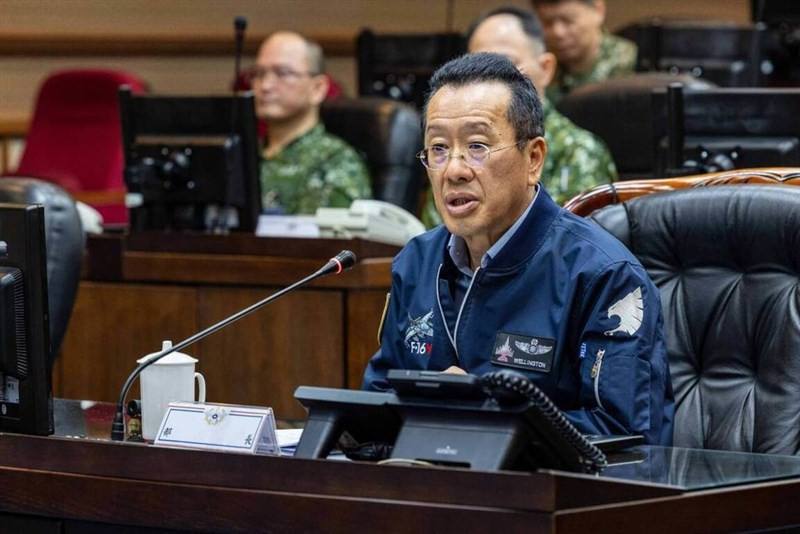
Taipei, April 25 (CNA) The computer-aided segment of the annual Han Kuang military exercises concluded on Friday, following 14 days of intensive wargaming incorporating elements in recent international conflicts and other realistic scenarios to strengthen the decision-making and responses of Taiwan's armed forces.
Defense Minister Wellington Koo (顧立雄) announced on Friday the conclusion of the segment, following 14 days of "nonstop" tabletop exercises in a high-intensity and high-stress environment, the Ministry of National Defense (MND) said in a statement that night.
According to Koo, the exercise was aimed at training commanders' decision-making abilities and staff officers' operational capabilities, with its core focus on simulating real combat conditions, verifying joint operational mechanisms, and strengthening combat readiness.
The scenario design integrated a progression of simulated enemy actions, beginning with gray-zone harassment tactics and gradually escalating to high-intensity military conflict, Koo said.
Tactics used in recent international conflicts were also incorporated into the simulation, along with multi-domain battlefield and hybrid threat elements, enabling both attacking and defending forces to conduct decision-making and response drills in a "highly uncertain" battlefield environment, he added.
To enhance command-and-control resilience, Koo said that during the exercise, military administrative and armament units, along with the Joint Operations Command Center, the tri-service coordination center and units at various operational levels, were dispersed and operated from separate locations.
Such arrangements were intended to verify that even in the event of coordinated enemy fire strikes, backup mechanisms would be able to take over immediately and maintain wartime command-and-control functions, he said.
Koo said the shortcomings identified in the computer-aided drills will be addressed individually and documented to serve as an important reference for future combat readiness training and wartime deployments.
He emphasized that with constantly evolving and diversifying threats, especially the possibility of enemy forces switching military exercises into a kinetic attack, the armed forces must enhance their early warning mechanisms and employ deception tactics and force preservation measures to ensure a successful transition between peacetime and wartime deployments.
Koo said the armed forces will continue working to build up defense capabilities and strengthen combat readiness, adding that the live-troops portion of the Han Kuang exercises in August will be a highlight.